AZAREL
A fouled hull is the most expensive thing in shipping that nobody looks at. DNV puts the fuel penalty from even a light slime layer at up to 20 per cent, and from heavy calcareous growth at up to 85 per cent. The same organisms are a biosecurity problem in their own right: shipping is estimated to account for somewhere between 55 and 70 per cent of established coastal and estuarine invasive species worldwide.
So the commercial case is unusually clean. Clean the hull more often, burn less fuel, emit less, and stop moving species between ports. Dry docking a vessel to do it is slow and costly, which is why in-water cleaning keeps growing, and why the robot that does it is an interesting machine.
What makes it hard
Almost nothing about hull cleaning is difficult in clear water. Everything about it is difficult in a working harbour.
You cannot see
Port water is the worst optical environment in commercial marine robotics. Suspended sediment and biological load mean a camera returns backscatter from its own lights and little else. Anything the vehicle knows about its surroundings has to come from acoustics, contact, or dead reckoning.
You cannot easily tell where you are
A hull is a large, smooth, curved, feature-poor steel surface. A DVL pointed at it gets range but little texture to track. GNSS is gone the moment you submerge. Yet coverage is the entire product: a cleaning run that misses ten per cent of the hull has not delivered ninety per cent of the value, because fouling regrows fastest from the patches left behind.
The vehicle fights its own wake
Holding position near a large flat surface is not the same problem as holding position in open water. Thruster wash reflects off the hull and pushes back, added mass changes near a boundary, and the vessel itself may be moving slightly at its berth while a current runs past. A controller tuned in open water will not behave the same way six inches from steel.
The worst geometry is where the worst fouling is
Fouling concentrates in niche areas — sea chests, thruster tunnels, rudder gaps, around the propeller. These are exactly the places a vehicle can wedge itself or wrap a tether, and they are the reason a cleaning contract is not simply a matter of driving in straight lines.
What you would build in simulation
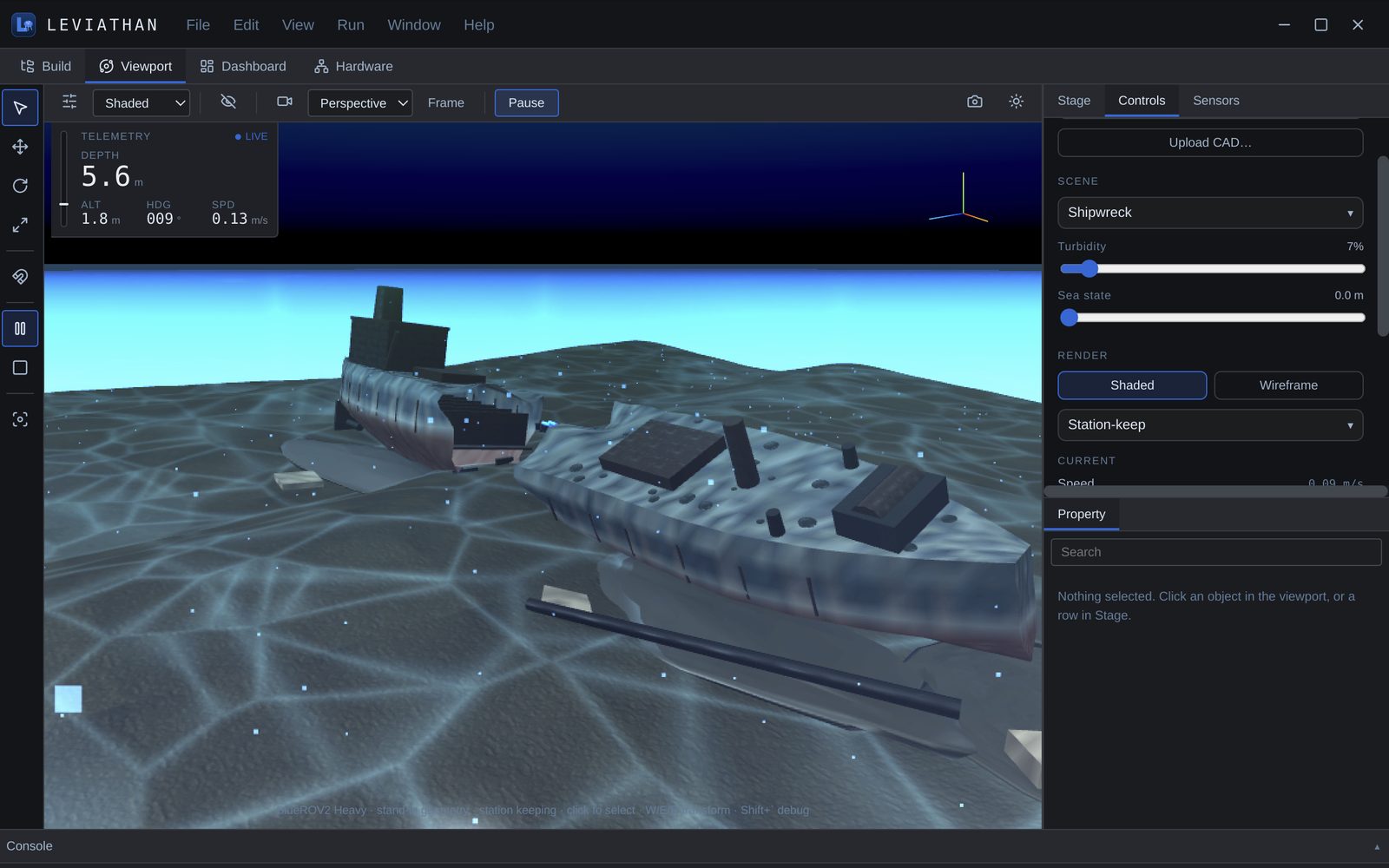
The point of simulating this is not to produce a demonstration video. It is to fail thousands of times cheaply in the specific ways that cost money in a real harbour.
- The actual hull. Bring in the vessel geometry rather than a stand-in box, and derive hydrodynamic coefficients from that mesh. The shape of the hull is the shape of the problem.
- Near-boundary behaviour. Six-degree-of-freedom dynamics with off-diagonal added mass gives you a vehicle that responds differently close to a large surface than it does in open water.
- Turbidity at the far end of the range. Not a mild haze. The regime where the optical payload contributes nothing and the autonomy has to notice.
- The tether. Lumped-mass cable with contact, because on a hull the tether is what ends most dives.
- Coverage as a scored task. Percentage swept, overlap, missed patches, time. A number you can compare between two versions of a controller.
Why this matters beyond one company
There are now many hull cleaning ventures, and each is independently rebuilding the same three things: localisation on a featureless surface, station keeping against a wall in current, and a coverage planner that can prove what it swept. None of that is anyone’s competitive advantage. The cleaning head is.
If the common part can be developed and, more importantly, measured in a shared environment, then a claim like “99 per cent coverage” becomes something a port authority or a class society can ask to see reproduced, rather than a line in a brochure. That is the shift the field needs more than it needs another vehicle.