AZAREL
Everything below the waterline on an offshore wind farm starts ageing the moment it is installed, and none of it is visible from above. Monopiles and jacket foundations corrode and accumulate marine growth. Grouted connections develop voids under cyclic load. Inter-array cables move, abrade and become exposed. And the seabed itself migrates: scour around a foundation removes the material the structure is standing in, which is the failure mode that matters most and the one you can least afford to guess at.
The inspection work is well established. Small ROVs, deployed from crew transfer vessels rather than dedicated support ships, carry cameras, imaging sonar and measurement tooling around foundations and along cable routes. It keeps divers out of a cold, high-current environment, and it is cheaper. The question is whether it scales, because the number of foundations in the water is growing considerably faster than the number of people who can competently fly a vehicle beside one.
The constraints that actually bind
Weather windows
Offshore campaigns are scheduled around sea state. A lost day is a lost day of vessel hire, and the work does not move to a calmer week. Anything that makes a survey faster or lets it be flown in worse conditions has direct commercial value, which is a large part of why autonomy is attractive here.
Current beside a hard structure
Tidal flow around a monopile does not behave like flow in open water. It accelerates around the structure, separates behind it, and forms recirculation that pushes a vehicle sideways in ways that change with heading. A vehicle holding a standoff of a metre from steel, in flow like that, is doing something genuinely difficult, and getting it wrong means contact.
Consistency between campaigns
The purpose of inspection is trend, not snapshot. Is the scour pit deeper than last year? Is that crack longer? That question is only answerable if the two surveys were flown comparably. Today, a great deal depends on which pilot was on which boat.
What a simulator contributes
Three things, in descending order of how ready they are.
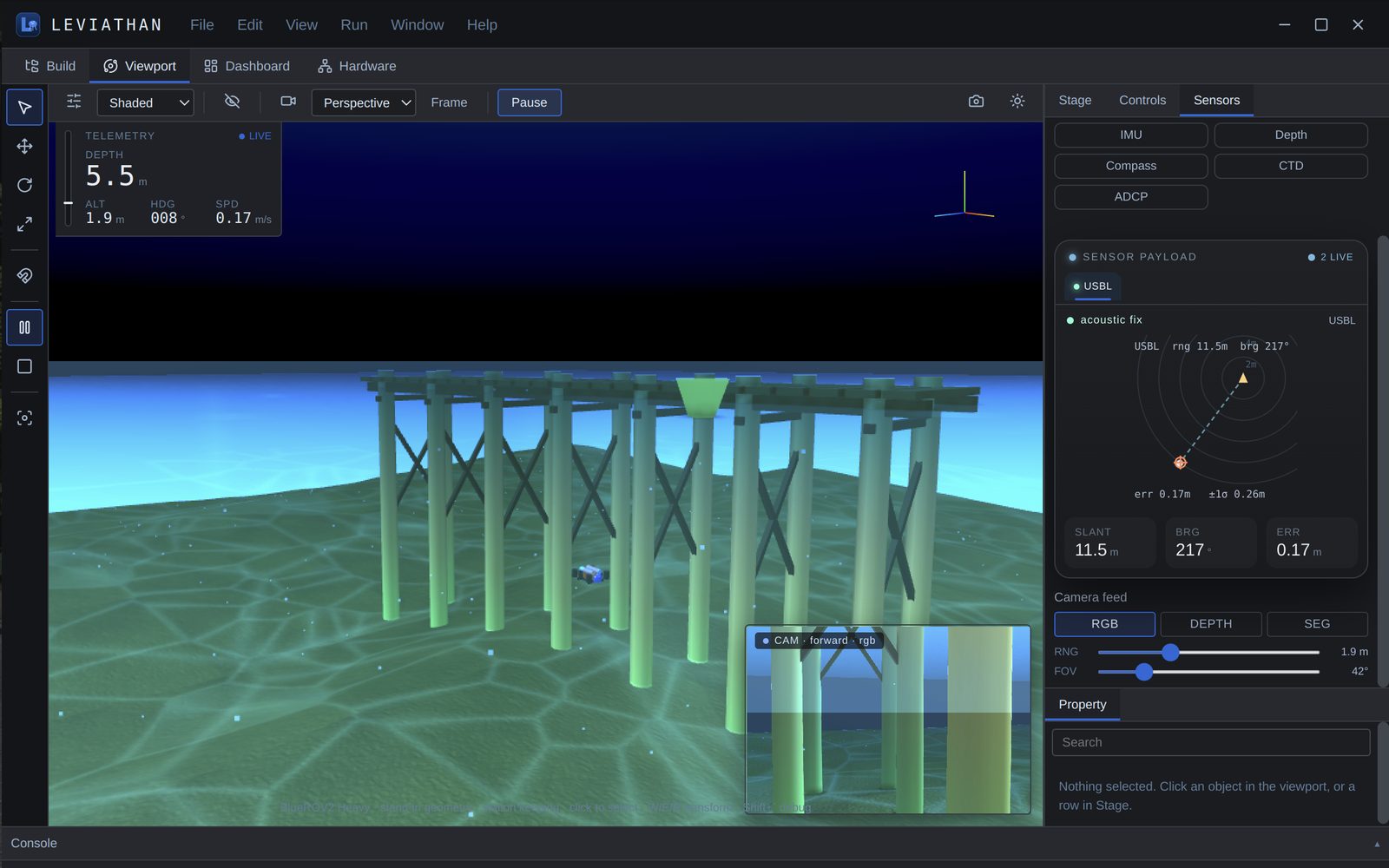
Pilot and controller hours. A station keeping controller can be tuned against a simulated flow field around a structure before it is ever asked to do it beside a real one. This is the least glamorous and most immediately useful application: it costs nothing to crash into a simulated monopile.
Repeatable survey paths. If the inspection is a scored task rather than a piloting exercise — fly this path, hold this standoff, capture this coverage — then the thing being compared between years is the structure, not the operator.
Perception training data. Marine growth, anode depletion, coating damage and crack detection are all vision and sonar classification problems, and all of them are starved of labelled data. Synthetic imagery with per-pixel labels is not a complete answer, but it is the only way to get volume.
The reason this matters for the field
Offshore wind is the clearest case in commercial marine robotics where demand is outgrowing skilled labour. That pressure will be answered by autonomy whether or not the autonomy is ready, and the difference between those two outcomes is entirely a question of how much the vehicles were made to practise, and whether anyone measured it.
An inspection autonomy stack that has flown ten thousand simulated approaches to a structure in current, and can produce a scorecard for each of them, is a different proposition to one that has been demonstrated twice on a calm day. The industry will eventually require the first kind. It would be better if it required it before an incident rather than after one.