
DOC 01GETTING STARTED
What is LEVIATHAN
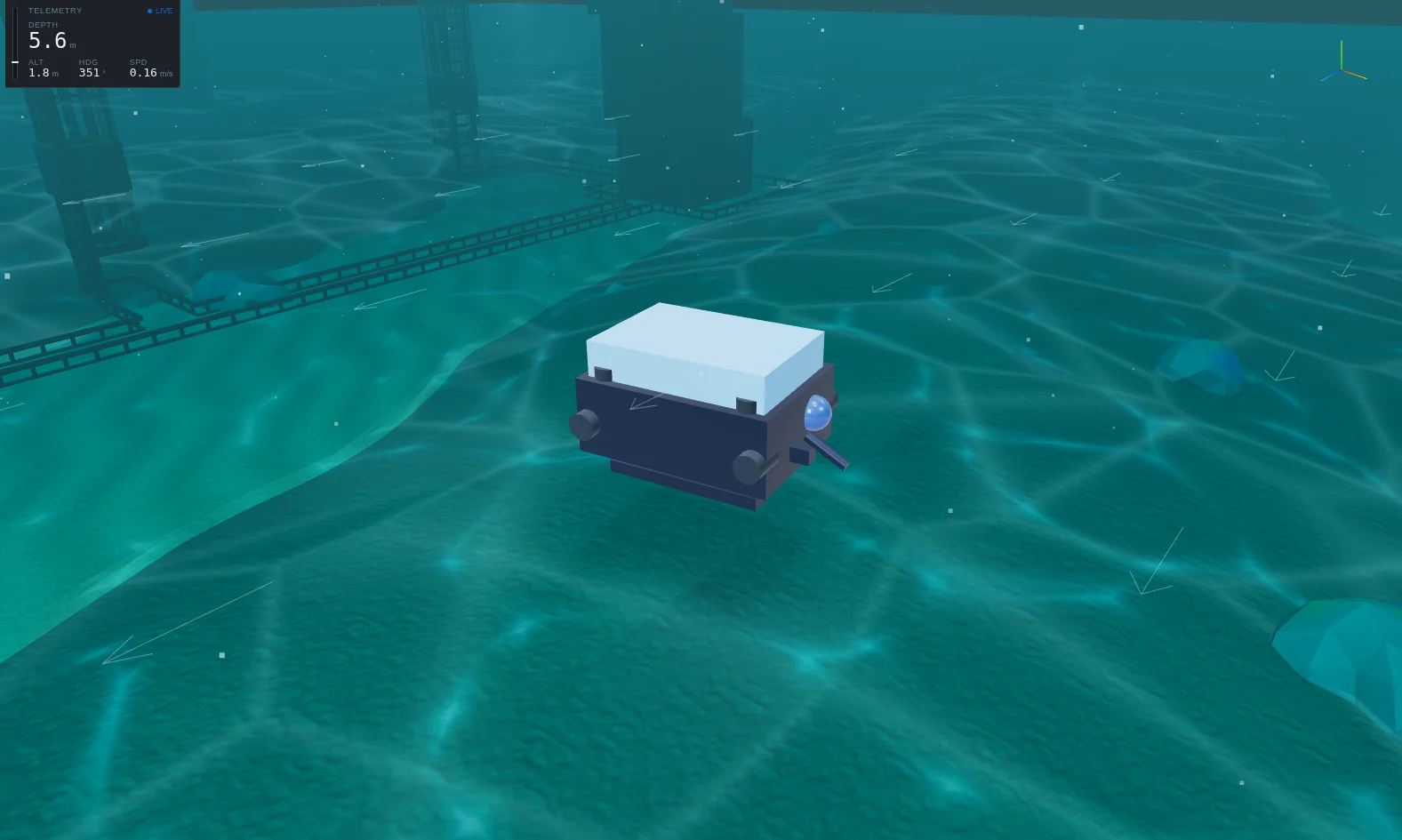
LEVIATHAN is a development environment for marine robotics: AUVs, ROVs, surface vessels and hull-working robots. You simulate a vehicle, its sensors and the water it works in, compare what the sensors saw with what was actually there, estimate the vehicle's state, train and grade its behaviour, and bring in firmware and hardware interfaces, all before anything goes in the water.
What it does
LEVIATHAN is organised as a stack, from the world and its physics up to autonomy and hardware. Every layer shares one vehicle model, one ocean and one set of conventions.
- Vehicle and ocean simulation. Six-degree-of-freedom dynamics for remotely operated vehicles, autonomous underwater vehicles, a surface vessel and a glider. Thrusters, control fins, added mass and damping are modelled, along with currents, eddies, tides, waves and seabed terrain. This is the FAB Engine.
- Sensor simulation. Optical, acoustic, navigation and oceanographic sensors, from a radiometric underwater camera and a forward-looking imaging sonar to DVL, IMU, USBL, LBL, GPS, CTD and ADCP. See Sensors.
- Ground truth. The simulator knows what each pixel and sonar cell actually saw. That includes range and depth, surface normals, labels, object identity, how surfaces moved between frames, and which surfaces produced each sonar return. See Perception ground truth.
- Synthetic data. Captures export as LEVIATHAN native datasets and as COCO, KITTI, depth and optical-flow formats. See Synthetic data and export.
- Perception algorithms. Classical and learned vision, sonar detection and tracking, and camera–sonar association, each evaluated against ground truth and graded by evidence. See Perception and computer vision.
- Localization. An error-state Kalman filter that estimates vehicle state from IMU, DVL, pressure, magnetometer and USBL measurements and can drive the controllers in a closed loop. See Localization.
- Evaluation. A suite of control tasks with stage-attributed verdicts, robustness sweeps and domain randomisation. See Learning and evaluation.
- Development workspaces. A code editor with terminals and language tooling for your own robot software, alongside hull fouling and cleaning analysis, an electronics harness and firmware bench that runs firmware on an emulated microcontroller, and hydrographic survey processing.
Core capabilities
| Area | What exists | Used from | Character |
|---|---|---|---|
| Vehicle dynamics | Fossen 6-DOF equations of motion, RK4 integration, thruster allocation, fins, surface hydrostatics | Viewport, Dashboard, service | Analytic Reference-checked |
| GPU-batched dynamics | The same equations for thousands of environments in parallel, checked against the CPU model | Learning tools | Reference-checked |
| Ocean | Currents with depth shear, eddies, harmonic tides, Airy and JONSWAP waves, wind, seabed grids, sound-speed profiles, seawater absorption | Viewport, Dashboard | Analytic |
| Scenes | Nine built-in scenes with 3D structure models and matched analytic environments | Viewport | Content |
| Vehicles | Nine built-in vehicles; URDF, SDFormat and MJCF import; CAD hull upload | Viewport, Dashboard | Preset parameters |
| Camera | OpenCV pinhole camera with optional Brown–Conrady distortion, underwater radiometry and per-pixel ground truth | Viewport → Sensors → Camera | Canonical |
| Imaging sonar | Sampled forward-looking sonar with a relative-return model, per-cell contributors and validity codes; CPU reference and bit-identical GPU backend | Simulation service | Canonical Reference-checked |
| Navigation sensors | Four-beam DVL, strap-down IMU, pressure, magnetometer and USBL measured from World snapshots, with optional keyed noise | Simulation service | Canonical |
| Other sensors | Side-scan, multibeam bathymetry, USBL, LBL, GPS, CTD, ADCP, pressure, compass, LiDAR, stereo, depth, thermal and event cameras, radar | Viewport, Dashboard | Analytic |
| Motion and track ground truth | Surface correspondence, optical flow, scene displacement, instantaneous motion field, object tracks | Simulation service, export | Canonical |
| Camera–sonar ground truth | Exact-time contributor ground truth and sonar observability queries between a camera and a sonar | Simulation service | Canonical |
| Perception algorithms | Feature matching, two-view geometry, visual odometry, depth, detection, segmentation, tracking, flow, restoration, sonar detection and tracking, camera–sonar association, with evaluators and frozen benchmarks | Python library, benchmarks | Graded per capability |
| Localization | Error-state Kalman filter on canonical IMU and DVL, with pressure, magnetometer and USBL aiding; estimate-driven closed-loop control on the World | Simulation service, library | Validated in simulation |
| Evaluation | Task suites, stage verdicts, robustness bench, domain randomisation, comparison and regression | Dashboard | Analytic |
| Reinforcement learning | Gymnasium environments, PPO, SAC, TD3 and offline learners, observation and actuator fault models | Scripts and service | Library |
| Hull | Hull atlas, fouling growth, drag and fuel cost, crawler cleaning plans, simulated inspection | Hull workspace | Analytic |
| Hardware | Harness wiring and checks, PlatformIO project generation, RP2040 firmware emulation against simulated sensors | Hardware workspace | Emulation |
| External interfaces | ROS 2 bridge, MAVLink / ArduSub SITL connection, OpenUSD scene exchange | Dashboard panels, service | Interface |
| Code workspace | Projects, file editing, integrated terminals, language servers, project run commands launched as training runs | Code | Tooling |
| Accounts | Optional or required sign-in, single sign-on, sessions and API keys | Application, service | Tooling |
| Hydrography | CUBE-class gridding, motion and patch-test corrections, tide reduction, survey pipeline | Dashboard, service | Analytic |
How capabilities are characterised
LEVIATHAN contains models of very different kinds, and the documentation labels them so that a result can be read correctly.
| Label | Meaning |
|---|---|
| Canonical | Produced from an immutable snapshot of the canonical World. Results are content-addressed: the same inputs and seed give the same identity hash, and every channel declares its units and frame. |
| Analytic | A closed-form or low-order physical model evaluated directly by the simulation service. Fast and broad, with the assumptions stated in each section. |
| Reference-checked | An accelerated or alternative implementation tested against LEVIATHAN's own CPU reference. This is agreement between implementations, not validation against real-world measurements. |
| Validated in simulation | Tested against simulated truth over seeded, held-out scenarios, including faults and noise. No real-world evidence. |
| Partial, Baseline | Works in part with a key limit open, or exists with minimal evaluation. Used for perception algorithms. |
| Legacy | Still available for compatibility, but superseded by a canonical product. The page says which product replaces it. |
| Interface | An adapter to external software such as ROS 2 or ArduSub SITL. It works only when that software is installed. |
| Preset parameters | Numbers chosen for simulation, with their provenance recorded. They are not manufacturer-verified specifications unless stated. |
Scope
A few boundaries are worth knowing from the start.
- Simulation is not field validation. LEVIATHAN's models are physically based and tested against closed-form results and its own references. Agreement with a specific real vehicle, sonar or camera is not claimed unless a page reports it.
- Sonar intensities are relative. The canonical imaging sonar computes a physically modelled return relative to the source. It is not a calibrated received level. See Imaging sonar.
- Perception performance is demonstrated in simulation. LEVIATHAN includes perception algorithms and training code, but no trained weights ship, and transfer to real imagery has been measured on one dataset only, where it is weak. See Real data.
- Reinforcement learning and the canonical World are separate. The learning environments run on the analytic and GPU tiers. A vehicle in the canonical World is driven by the built-in controllers, on true or estimated state, not by a trained policy. See System architecture.
- No mapping or SLAM system. LEVIATHAN estimates vehicle state but does not build maps from it. See Mapping and navigation.