
DOC 02FAB ENGINE
Time, frames and determinism
Ground truth is only useful if everyone agrees on where and when it was taken. This page defines LEVIATHAN's coordinate frames and transform convention, its simulation clock, and what it guarantees when you run the same thing twice.
Coordinate frames
| Frame | Axes | Used by |
|---|---|---|
| World | NED: x north, y east, z down; origin at the sea surface | Vehicle pose, scene geometry, currents, normals in world coordinates |
| Body | FRD: x forward, y starboard, z down; origin at the centre of gravity. A vehicle's root link is its body frame | Velocities, forces, thruster and sensor mounts |
| Camera | OpenCV optical: x right, y down, z forward along the optical axis | All cameras, intrinsics, camera-frame normals, z-depth |
| Acoustic and inertial sensors | Sensor FRD: x along the boresight, y starboard, z down | Imaging sonar, side-scan, multibeam, DVL, IMU |
Attitude is roll φ, pitch θ and yaw ψ, applied in ZYX order: Rworld←body = Rz(ψ) Ry(θ) Rx(φ). Elevation in the sonar frame is positive downward.
The Viewport's 3D renderer uses its own display axes internally. Every value LEVIATHAN reports or exports is in the frames above.
Transform convention
A transform TA_B maps a point expressed in frame B into frame A:
Composition chains on the shared index. Directions transform by the rotation alone. A sensor's pose in the world is always formed as Tworld_body Tbody_sensor, and the mount transform Tlink_sensor is declared in the vehicle's document.
Simulation time
The canonical World keeps time as integers. Each physics tick has a length in whole nanoseconds, and a tick index k maps to time exactly:
- A time step must be a whole number of nanoseconds, so 0.02 s becomes exactly 20 000 000 ns. Steps that are not are refused.
- Changing the step starts a new epoch at the current tick. The list of epochs is part of the state's provenance.
- Seconds are derived from integers when the physics needs them, never accumulated, so long runs do not drift.
- The wall clock never enters simulation time.
Sensor schedules
Each canonical sensor samples at tn = phase + n · period, both in integer nanoseconds. A schedule belongs to the sensor and is usually declared in the vehicle's document. A sample is taken only when it falls exactly on a committed physics tick. A sample between ticks is reported as off-tick and refused, never snapped to the nearest tick or interpolated.
Capture groups
Over a time window, every scheduled sensor of every vehicle contributes its samples. Samples at the same instant form a capture group: one immutable snapshot per sensor, all taken from the same committed World state. Groups are ordered by time and members by sensor identifier, so nothing depends on the order of requests.
The canonical World
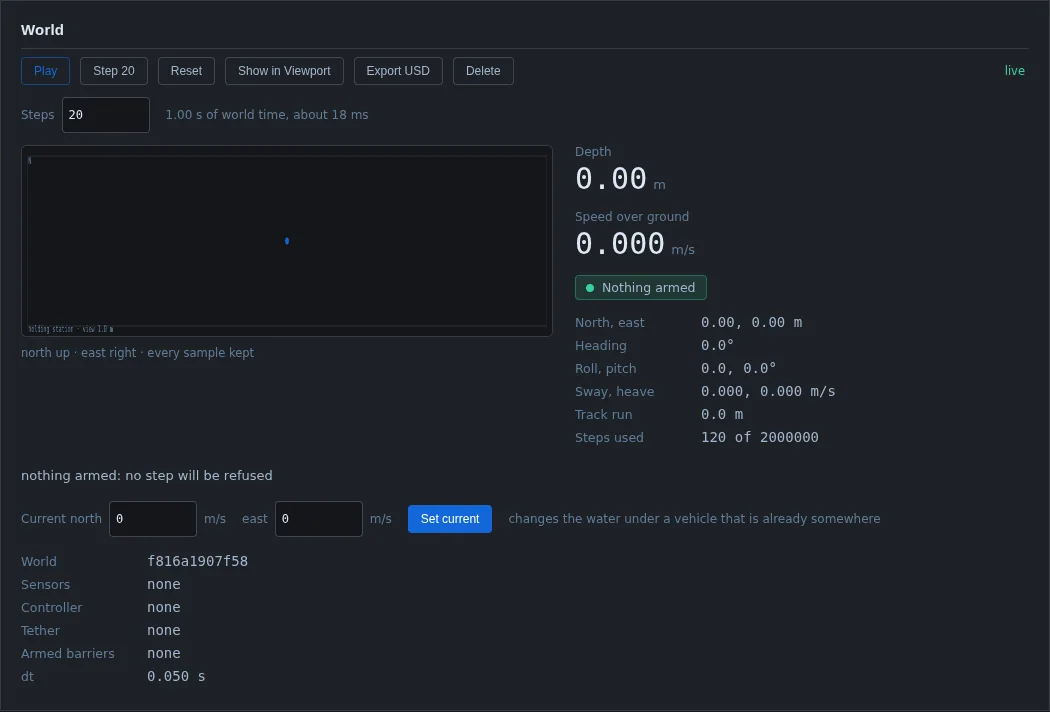
A World holds a scenario live between requests: one or more vehicles, an environment and their controllers. You create it, step it, read its state, change the current or a controller, take snapshots, and reset it. The Dashboard's World panel provides these controls, and the Viewport can follow a World live.
| Aspect | Behaviour |
|---|---|
| Step | Advance n ticks; only the new samples are returned |
| Edit | Replace the vehicle, environment, sensors or controller while keeping the current pose and velocity |
| Snapshot | Freeze the committed state at the current tick into an immutable, hashed record |
| Reset | Return to the start. There is no rewind to an intermediate tick |
| Lifetime | Worlds live in memory and do not survive a service restart; idle worlds are released after one hour |
| Capacity | Up to 32 open worlds, 2,000,000 steps each |
| Thruster faults | Refused on a live World; available in analytic scenario runs |
Determinism and identity
Canonical products are content-addressed. A snapshot, a measurement or a perception frame records a SHA-256 hash of its scientific content. Floats are canonicalised first: negative zero becomes zero, and every NaN becomes a single quiet NaN that means "missing". The hash contains no wall-clock time, request order or cache state, so equivalent inputs produce the same identity. Display products, such as an sRGB preview or a sonar display image, have separate hashes and never affect the scientific identity.
Randomness is keyed. A random draw is a pure function of stable identifiers: the root seed, the sensor, the sample index, the effect and the cell or beam. It does not come from a generator's hidden position. A sample is therefore the same whether it is produced alone, in a batch, or after a World reset. The seed enters a measurement's identity only when a random effect was actually drawn.
| Property | Status |
|---|---|
| Same spec, seed and frame, same build and platform | Bitwise identical. Tested in-process, across processes and across hash seeds |
| CPU and GPU imaging sonar | Bitwise identical on the tested scenes (see Imaging sonar) |
| Numerical equivalence across platforms | Not established |
| Bitwise identity across platforms | Not claimed |
On the analytic tier, each sensor draws noise from its own generator. Give a sensor a seed to make its noise sequence reproducible; unseeded noise differs between runs. GPU learning environments in single precision are not bitwise reproducible across hardware.